Most PLA vs PETG comparisons are written for one person with one printer: which spool should you load this weekend? A production buyer is asking a different question. You are deciding which materials to stock, which channels to sell them into, and which failure modes you are willing to absorb in volume — because when a material decision is wrong, it is wrong ten thousand spools at a time, and it comes back as returns, reviews, and dead inventory.
This comparison covers the same physics as the hobbyist guides — rigidity, heat, moisture — but each dimension ends where a buyer actually lives: what it means for SKU selection, scrap rates, logistics, and the trial order you run before committing.
The Short Answer for Production
If you only have thirty seconds: use PLA as your volume base and PETG as your functional range, and qualify both through the same supplier trial so the comparison is controlled. The table below is the compressed verdict — the rest of the article explains each row and where the exceptions bite.
| Dimension | PLA | PETG |
|---|---|---|
| Stiffness vs toughness | Rigid, dimensionally crisp — but brittle | Less stiff, noticeably tougher — bends before it breaks |
| Typical failure you will see | Snap/shatter on impact or drop | Deformation under sustained load; stringing if under-dried |
| Service temperature | Limited — softens around the mid-50s Celsius | Meaningfully higher, still below engineering resins |
| Moisture behavior | Absorbs moisture; symptoms are brittleness and popping | Absorbs moisture; symptoms are stringing, bubbles, weak layers |
| Fleet printing | Fast, forgiving, minimal per-machine tuning | Slower, needs profiles and drying discipline |
| Where it earns shelf space | Retail, education, display, e-commerce visual lines | Functional parts, tools, outdoor-adjacent, technical channels |
| Validation focus | Color consistency, dimensional accuracy, winding | Drying records, stringing control, batch-to-batch adhesion |
| Cost story | Cheapest per successful print when the part survives | Higher tolerance for abuse, fewer breakage returns |
Rigid vs Tough: How Each One Breaks
The cleanest way to feel the difference requires no lab. Print the same thin bracket in both materials and bend it. The PLA part resists, resists, then snaps with a click. The PETG part flexes, whitens slightly at the stress line, and takes a set instead of shattering. Neither result is “stronger” in an absolute sense — they are strong in different ways, and published material guides consistently place PETG’s impact resistance between PLA and ABS.
For a catalog owner, that difference is a returns question. A rigid, brittle material wins wherever parts must hold dimensional detail and stay put — display models, fixtures, enclosures that never get dropped. A tough, ductile material wins wherever parts get handled, clamped, dropped, or loaded — brackets, living hinges, clips, anything shipped to a customer who is not gentle. If your channel sells to schools or retail, PLA breakage in transit is a real complaint category; if your channel serves workshops and industry, PETG’s tolerance for abuse is why those customers ask for it by name.
One purchasing note: “PLA+” occupies the middle of this row. The plus usually signals modified impact behavior, but the term is not standardized across the industry — one supplier’s PLA+ is another’s basic PLA. That is why our own PLA+ pages explain the enhancement with test indicators rather than letting the plus sign do the selling, and why a buyer should ask what the plus means for the specific SKU being quoted.
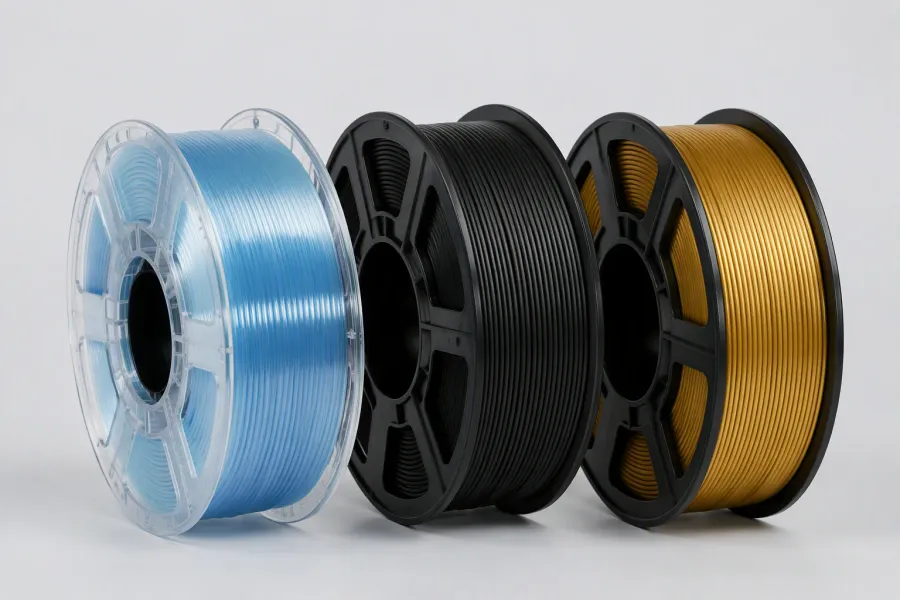
Heat and Environment: Where Each Material Fails
PLA’s best-known weakness is heat. Published polymer reviews describe thermal instability above roughly the mid-50s Celsius — which sounds abstract until you translate it: a closed car in summer sun, a part left on a windowsill, a component near any warm electronics. The part does not melt; it slowly relaxes and warps out of tolerance. If your customers print objects that live outdoors or near heat, PLA will generate the warranty conversation.
PETG handles meaningfully more heat before it deforms, which is why it is the usual recommendation when a part must survive a hot environment but does not justify engineering resins. Be precise with the claim, though: neither material is an engineering-grade heat solution — sustained load at higher temperatures is where PETG creeps, and outdoor UV exposure degrades both. For hot or sun-exposed applications, start the specification at PETG and validate against the actual service conditions.
When buyers ask about PLA vs PETG for outdoor use, the honest answer is that sunlight and rain decide as much as heat does. UV exposure embrittles both materials over time, and outdoor parts cycle through moisture in use, not just in storage. For parts that live outdoors seasonally — garden décor, signage, exterior fixtures — PETG is the defensible choice and PLA is a return waiting to happen. For permanent outdoor or load-bearing duty, set expectations accordingly and specify a UV-stable engineering resin, which sits outside both materials’ working envelope.
Destination markets deserve a place in this decision, not just applications. A catalog bound for a hot, humid climate faces a different combination of transit stress and shelf stress than one sold in a temperate region — the same SKU may need stricter packaging, faster stock rotation, or a material mix tilted toward the tougher polymer. Material selection and logistics planning are one decision at the quote stage, which is why Incoterm, carton spec, and destination belong in the same conversation as resin choice.
Moisture: The Logistics Dimension
Here is the dimension hobbyist guides underweight and importers cannot afford to. Both materials are hygroscopic — they absorb water vapor from the air — but they fail differently. Wet PLA prints with popping sounds and turns brittle; wet PETG strings, bubbles, and lays down weak layers. Recent published work confirms what operators already knew: drying PETG before printing measurably improves the finished part’s properties.
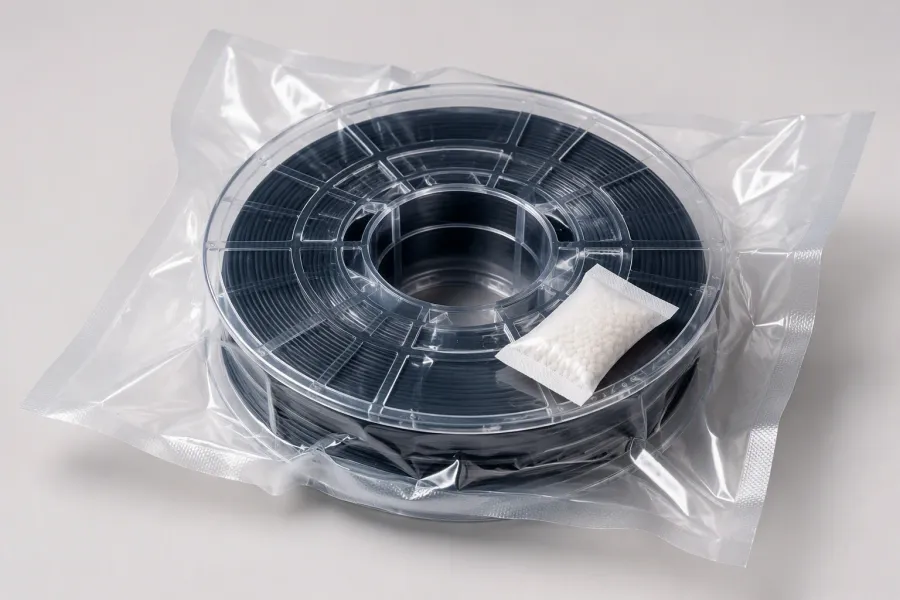
For a buyer, moisture is a supply-chain variable, not just a workshop one. Spools crossing an ocean into a humid market arrive only as dry as their packaging kept them. That is why we seal every spool in vacuum film with desiccant inside a carton, and why the moisture question to ask any supplier is not “is it dry?” but “what did the seal survive between your line and my dock?” — plus, on your side, storage discipline for opened stock.
That discipline is a written protocol, not a habit: first-in-first-out rotation for sealed stock, a defined dwell limit for opened spools in ambient humidity, and re-drying guidance per material before those spools return to production. Ask a candidate supplier for their recommended re-drying settings for each resin they quote — a supplier who provides validation settings per resin is one who can hold this conversation in specifics rather than adjectives.
Fleet Printing Behavior: Operator Hours and Scrap
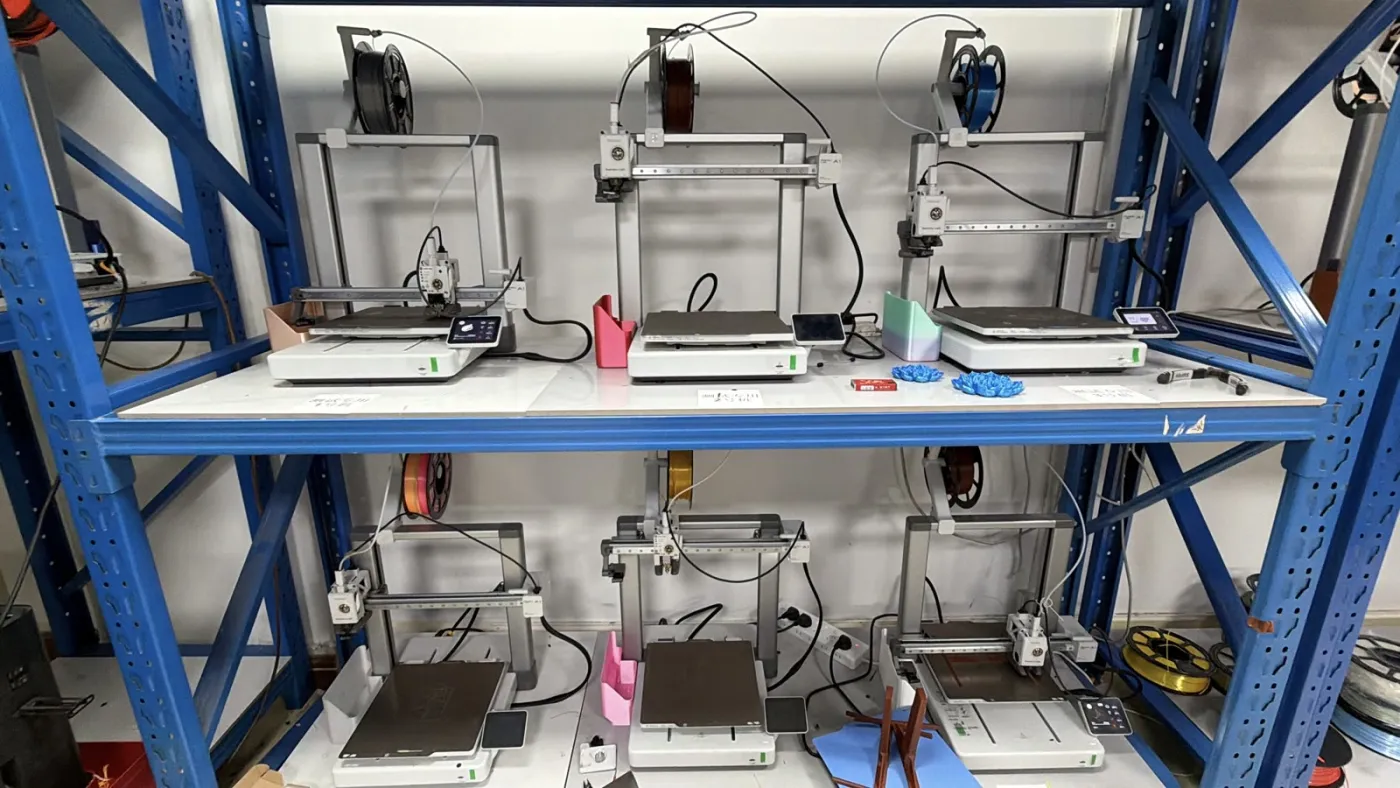
On a single printer, PETG’s quirks are an afternoon of tuning. Across a fleet, they are a line item. PLA runs fast, adheres reliably, shrinks little, and forgives generic profiles — which is why print farms default to it for anything that does not need toughness. PETG wants a per-machine profile: managed temperatures to control stringing, attention to bed adhesion, and drying discipline for opened spools. None of that is difficult; all of it is labor, and labor scales with head count.
The fleet decision rule is therefore about mix, not loyalty: run PLA where speed and surface finish pay the bills, reserve PETG lines for the jobs that need the toughness, and hold both to the same dimensional standard — 1.75 mm at ±0.02 mm, in-line monitored during production, with batch-level records available on request (per company-confirmed records). A supplier who cannot show you those logs for each material is asking your fleet to absorb their process drift.
Price per Kilogram vs Cost per Successful Print
The kilogram price is the least interesting number on a filament quote. What a business actually pays is the cost per successful print, and that is where the two materials converge more than their price tags suggest. A cheaper spool that produces stringy parts, jammed nozzles, or breakage returns is more expensive than the pricier spool that runs clean — and a material mismatch (brittle PLA sold into a rough-handling market) does its damage after the sale, in reviews and refunds.
When you compare suppliers rather than materials, the same logic compounds: add freight, duty, scrap rate, and the operator hours each material demands, then compare landed outcomes rather than quoted kilograms. The supplier who quotes a few cents higher but ships sealed, batch-traceable, diameter-logged spools is usually the cheaper one by the only metric that reaches your P&L.
Matching Material to Channel: A SKU Framework
Use the comparison as a shelf-planning tool rather than a winner-picking exercise:
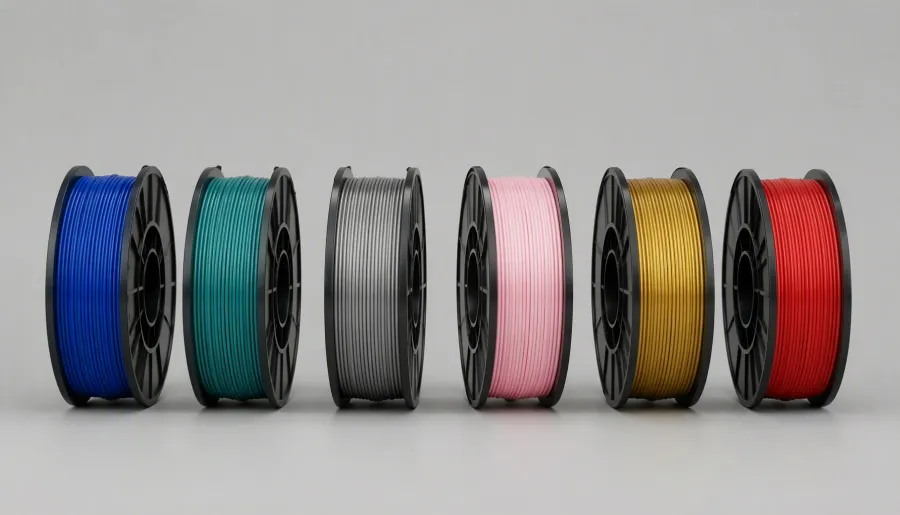
- Retail and e-commerce visual lines: build the catalog on PLA filament supply — maximum color range, best surface, lowest return friction on cosmetic grounds. Matte PLA differentiates shelf presence where gloss is the commodity.
- Education: PLA for printability and forgiving profiles in supervised settings, PETG for parts students handle repeatedly.
- Workshops, tools, technical channels: PETG filament supply as the default functional range; PLA only for jigs that never leave the bench.
- Outdoor-adjacent products: PETG as the floor requirement — with honest expectations set about UV and heat limits.
- Print farms and service bureaus: PLA for speed-critical jobs, PETG for durability-critical jobs, qualified as one controlled pair.
A practical starting mix for a mixed-SKU trial mirrors what works in catalogs generally: a base of core colors in the majority, with growth colors in a smaller share — structure that keeps cash out of slow movers while still proving the supplier’s color consistency. The split is a planning heuristic, not a rule; your channel data should override it within a season.
Qualifying Both Materials in One Trial
The cheapest way to settle PLA vs PETG for your catalog is a single controlled trial — the same second-source qualification process we run with filament buyers, applied to both materials at once. Order a mixed-SKU trial — spools of each material in the colors your channel actually sells, drawn from two independent production batches so you are validating repeatability, not luck. Print the same test parts your customers actually buy, on your own machines, with pass/fail criteria written before the first print: dimensional tolerance held, no stringing outside limits, layer adhesion consistent across both batches, net weight as specified.
Run the trial against the supplier’s paperwork — diameter logs, drying records, batch traceability — and you will learn more in two weeks than any comparison article can tell you. If the file includes a third-party audit, our walkthrough of what a production assessment actually covers shows which parts of it count as evidence. Our PLA and PETG supply pages, linked in the framework above, describe the qualification path for each material, and a look at how the filament itself is manufactured explains the process records worth requesting alongside your samples. More about FilaSource and the second-source model is on the homepage — the short version is that we would rather earn your PETG line after your PLA trial than win both on a promise.
Frequently Asked Questions
Is PETG stronger than PLA?
“Stronger” splits into two answers. PLA is stiffer and holds finer detail; PETG is tougher and resists impact — it bends where PLA snaps. For parts that get dropped or loaded, choose PETG; for parts that must stay rigid and crisp, choose PLA.
Does PETG need to be dried before printing?
Yes, once opened or poorly stored — and published testing confirms drying measurably improves printed part properties. Symptoms of wet PETG are stringing, bubbles, and weak layers. Ask your supplier for their per-material drying spec rather than assuming line-side drying was enough.
Is PLA biodegradable?
Not in any everyday sense. PLA degrades under industrial composting conditions — controlled high heat and humidity — not in home compost, soil, or ocean. Marketing it as generically “biodegradable” overstates the case; accurate wording is “industrially compostable.”
Is PETG food safe?
That is a certification question, not a material question. Food contact compliance depends on the specific SKU passing regulatory review for its formulation and colorants — never on the material category alone. Serious suppliers answer per SKU, with documents, not adjectives.
Which is cheaper for production: PLA or PETG?
PLA usually wins on running cost — faster printing, less tuning, less drying labor. PETG earns its premium wherever breakage, heat, or handling would turn a cheap part into an expensive return. Price per successful print, not per kilogram, is the number that matters.
Can one supplier qualify both materials in a single trial?
Yes — and it is the better experiment. A mixed-SKU trial order covering PLA and PETG in your real selling colors, from two independent batches, validated against the supplier’s process records, settles both materials and the supplier’s consistency in one pass.