The first time you stand next to a running extrusion line, the surprising part is how unhurried it is. Pellets pour in at one end. A thread barely thicker than pencil lead emerges at the other, passes a laser gauge, and winds itself onto a spool with no drama at all. Everything a printer will later do with that spool — every dimension it holds, every hour of unattended printing — was decided in those few quiet meters.
This walkthrough explains how 3D printing filament is made, stage by stage, from pellet to sealed spool. It draws on the production records and a third-party assessment of a working facility, and it is written for buyers: at every stage, some batches come out right and some do not, and the difference between a good supplier and a loud one is usually visible in how they handle that stage. If you source filament for a brand, a distribution channel, or a print operation, the process itself is your best set of evaluation questions.
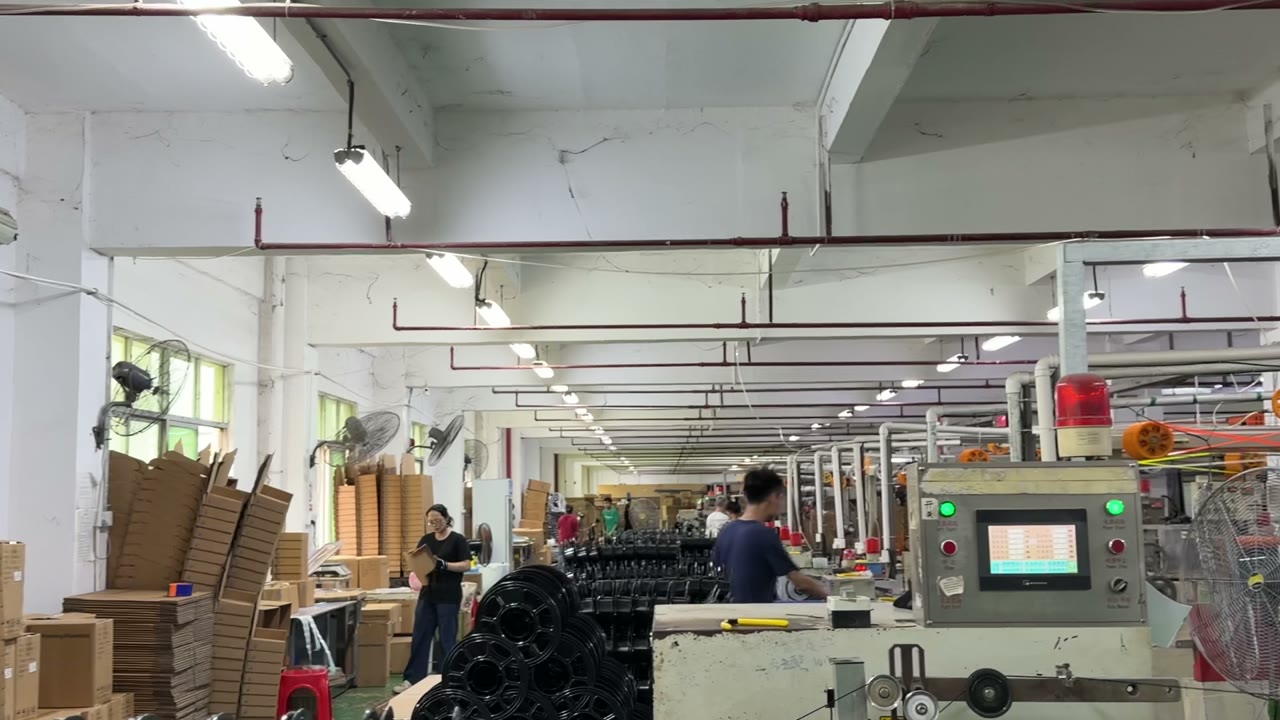
What Filament Starts As: Pellets, Masterbatch, Additives
Every spool begins as thermoplastic pellets — small granules bought by the ton. PLA pellets come from plant starch, typically fermented from corn. PETG is a glycol-modified PET formulated for toughness and easier processing. The base resin determines most of what a printer experiences: stiffness, heat behavior, moisture sensitivity.
Color enters as masterbatch: concentrated pigment granules blended into the base pellets at a defined ratio before extrusion. Specialty lines add more — matte surface agents, glow pigments, carbon or glass fiber. Each additive changes the melt behavior slightly, which is why an experienced plant treats a new colorway as a small process-engineering task, not a paint-by-number change.
Three things go wrong at this stage. Cheap or recycled pellets carry inconsistent melt flow. Poorly dispersed masterbatch produces streaks and color drift between batches. And pellets that have already absorbed moisture in storage import that moisture into the line. A supplier who cannot tell you the pellet source for a given material, the masterbatch ratio, or how color matching is approved is asking you to trust the input end of the process to luck. Color approvals should rely on physical samples first, Pantone references second — never on screen images.
Drying: The Step That Decides the Batch
Most printing resins are hygroscopic: they pull water vapor out of the air. Feed damp pellets into a hot barrel and the water flashes to steam inside the melt. The symptoms arrive later, at the printer: popping sounds, bubbles in the strand, brittleness, stringing that no temperature profile fixes. By the time a customer notices, the cause happened hours earlier, in a dryer.
This is why pellet drying sits at the head of the process rather than at the end. The partner facility assessed for FilaSource runs thirty dedicated pellet dryers, per the Intertek Production Assessment — capacity that exists precisely because drying cannot be skipped or rushed when you run industrial volumes.
Each material has its own drying temperature and duration. PETG and engineering resins need it as much as PLA does. When you evaluate a supplier, ask for the per-material drying specification and how drying is verified before extrusion. A supplier who cannot produce that spec is not controlling moisture; they are hoping it is fine.
Extrusion: Where Diameter Is Born
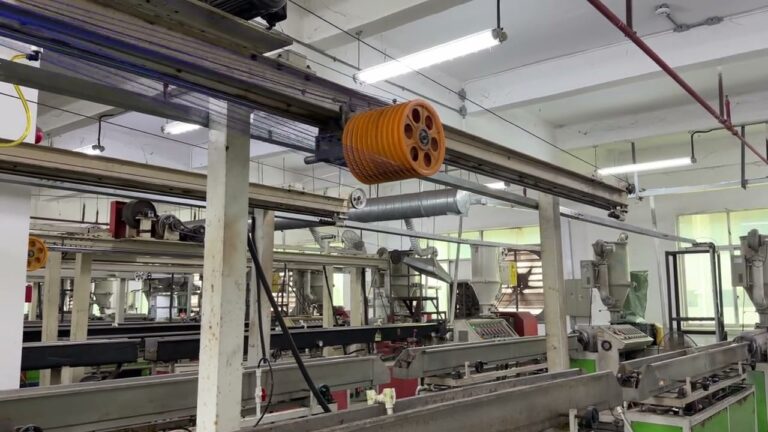
Extrusion is the heart of the process. Pellets feed into a heated barrel where a rotating screw melts, mixes, and pressurizes them. The melt is forced through a die that forms a continuous strand at roughly the target diameter — 1.75 mm and 2.85 mm are the two common standards. The line then pulls the strand at a controlled speed, and it is that balance between die output and pull speed that actually sets the final diameter.
The Intertek assessment covering our filament manufacturing facility lists 71 extruder machines across two equipment groups — one group two years old, the other three, at the time of review. Line count matters to a buyer for one reason: it determines how many different materials and colors can run simultaneously without rushing changeovers — and rushed changeovers are where cross-contamination and first-meter inconsistencies are born.
What goes wrong here is well known to anyone who has chased a mystery clog. Temperature drift changes melt viscosity, which drifts diameter. A worn die starts producing ovality instead of round. Contamination in the melt becomes a lump that later grinds in a feeder or blocks a nozzle. None of this is visible on a finished spool. It is only visible in the monitoring records — which is exactly what you should ask to see.
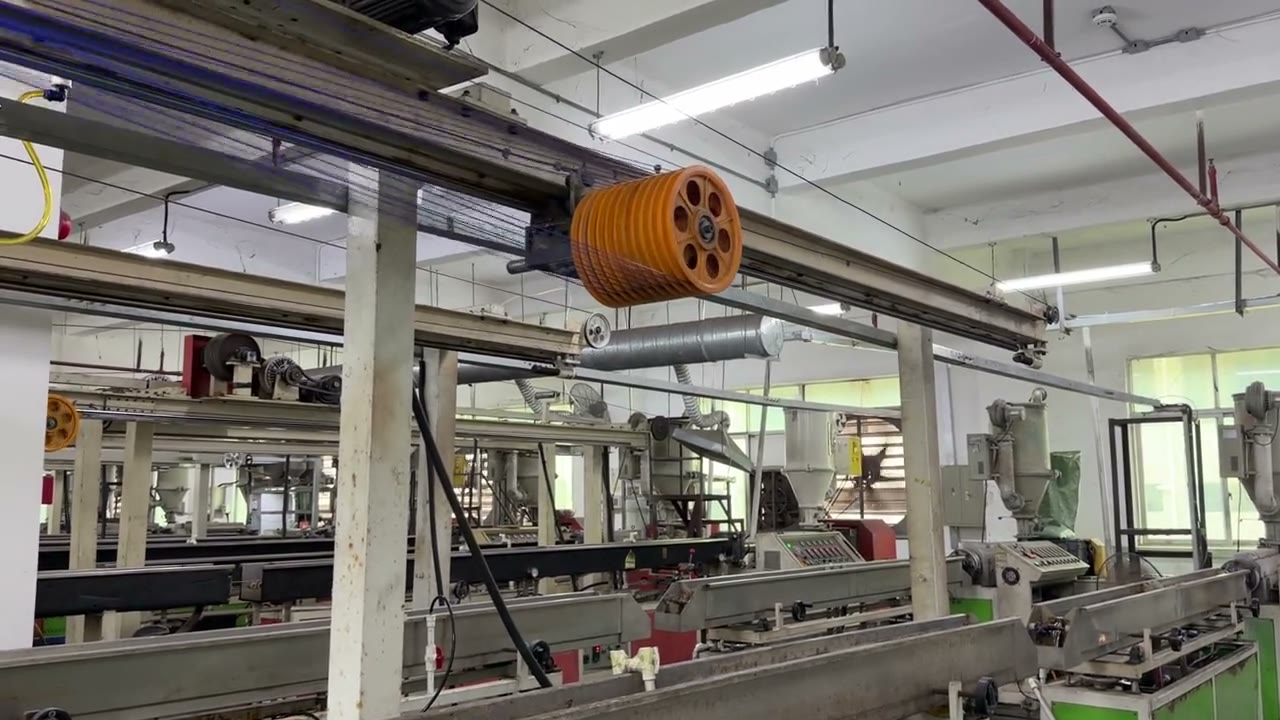
Cooling and Calibration: Holding ±0.02 mm
The hot strand has to solidify without internal stress. The choice between a temperature-controlled water bath and an air-cooling track is a process decision, not a preference: slower lines running heat-sensitive resins can shed heat in moving air, while higher-speed lines need water because air alone cannot pull heat out of the strand fast enough. Cooling that is too aggressive — or too shallow to reach the core of a thick cross-section — locks in internal stress and hurts roundness, and a roundness problem at this stage becomes an ovality reading at the gauge and intermittent under-feeding at the customer’s printer.
Immediately after cooling, the filament passes a laser micrometer that reads its diameter continuously along the length. Modern lines close the loop — when diameter drifts, pull speed adjusts automatically within seconds. The buyer’s question at this stage is what the cooling method is for the specific material you are ordering — the answer tells you whether the process was engineered for that resin or inherited from a different one.
Tolerance is where production filament separates from hobby extrusion. FilaSource’s specification is 1.75 mm with a tolerance of ±0.02 mm, monitored in-line throughout production. For a printer, that number is not decoration: undersized filament under-extrudes and weakens parts, while oversized filament grinds in the drive gear or jams at the nozzle. Across a fleet of machines, tolerance drift means recalibrating everything — which is why print farms care about diameter records more than almost any other document.
The buyer’s question is never just “what is your tolerance?” It is “how is it verified?” — measured on both axes to catch ovality, at what frequency, and whether the reading is logged per batch. A specification without a measurement method is a brochure line.
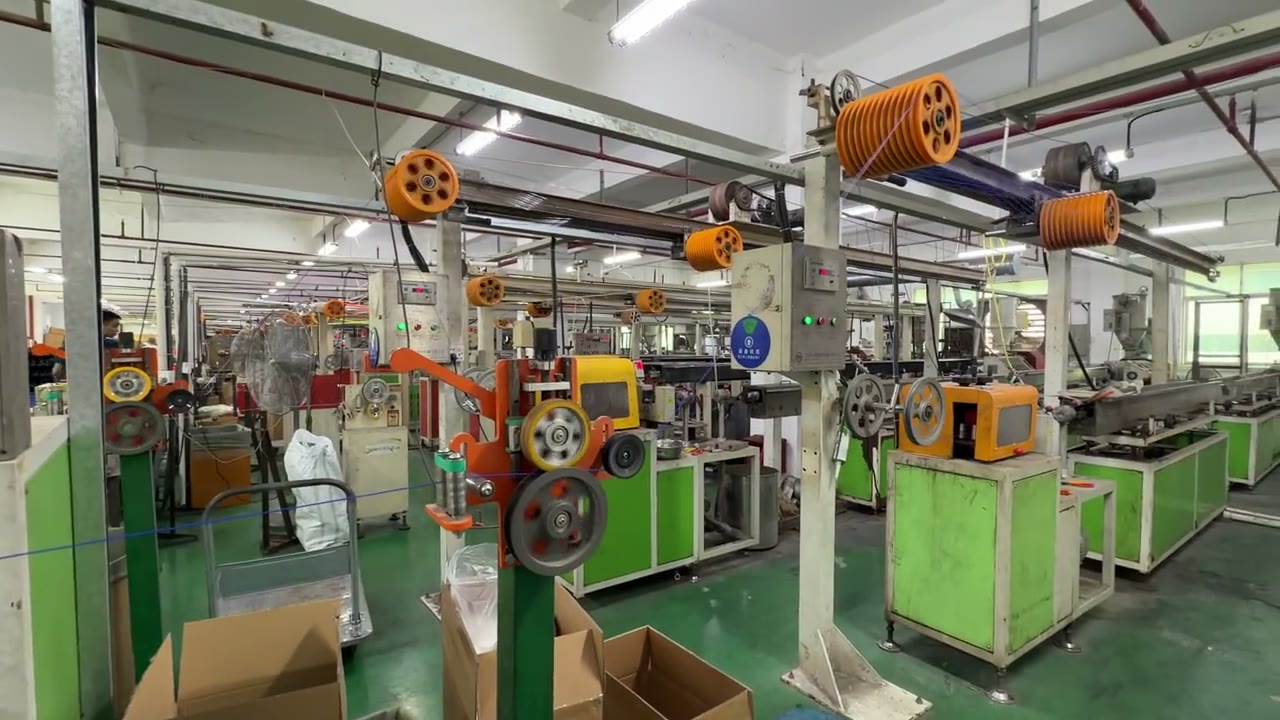
Winding, Weighing, Sealing
A calibrated strand still has to survive its spool. Winding controls tension and lay pattern so the filament feeds cleanly from the outside in; a crossed wind or a loose end tucked under later layers becomes a tangle halfway through a long print. Ends are fixed, spools are labeled, and each spool is weighed. Net weight — the material you actually paid for — is recorded separately from gross weight with the spool included, because that distinction is where short-weight complaints hide.
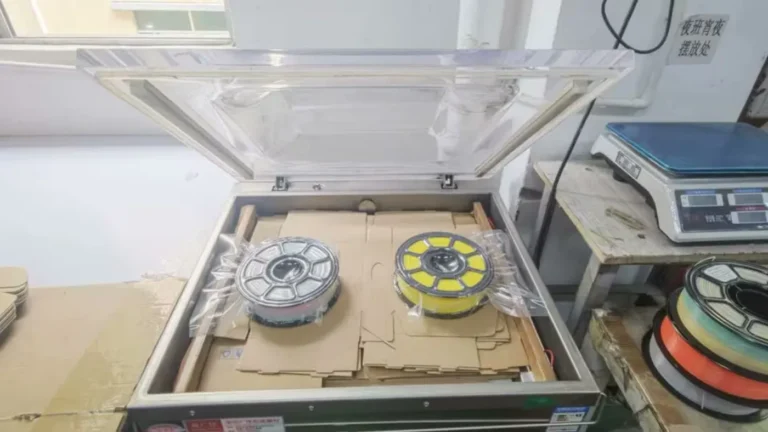
Then comes the step that protects everything before it: sealing. Each spool goes into a vacuum bag with desiccant before boxing. For hygroscopic materials crossing an ocean into humid climates, the seal is not packaging theater; it is the only thing standing between a verified batch and a moisture problem on arrival. Unconditional guarantees about winding or moisture do not survive contact with real logistics. What a controlled process offers instead is winding standards, sealing checks, and records that let any problem be traced to a batch rather than argued about.
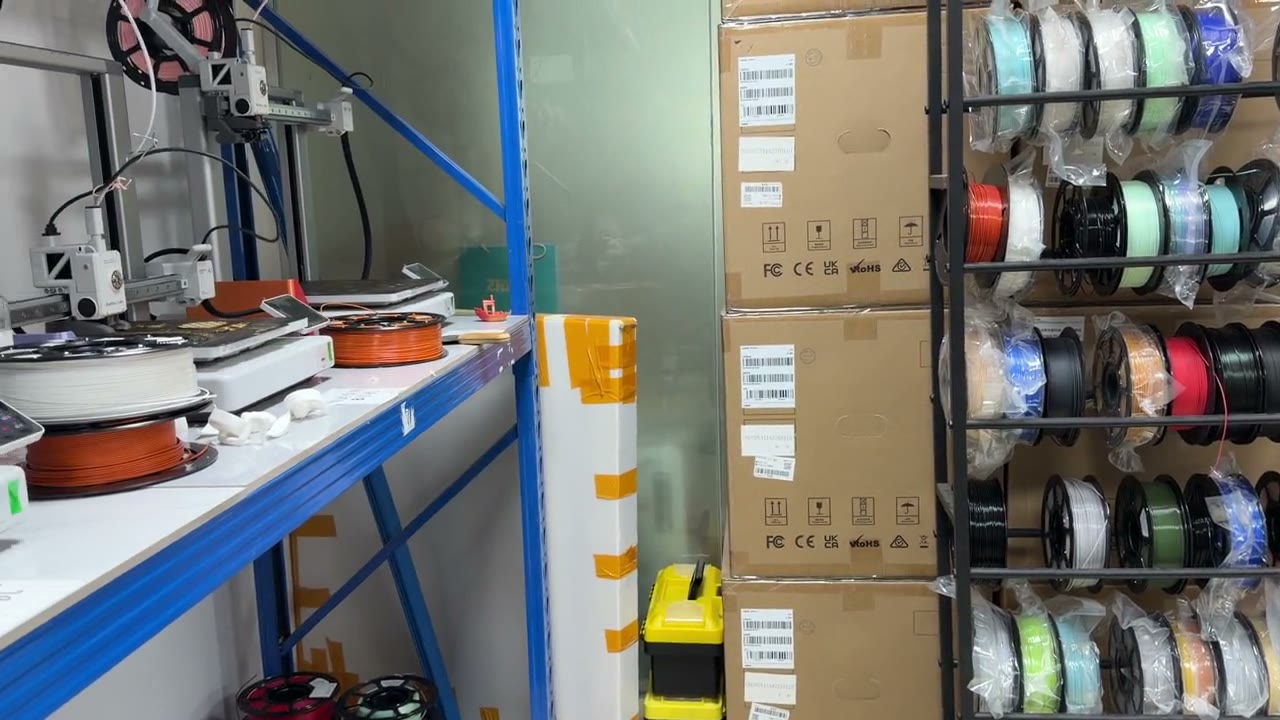
Quality Control: What Actually Gets Checked
How the four QC layers work in practice — and the records each produces — is covered in depth in inside filament quality control.
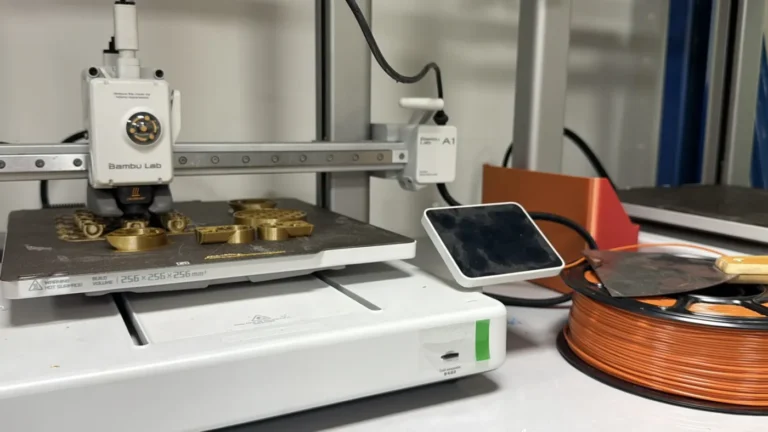
Quality control in filament manufacturing is layered, and each layer produces a document you can ask for. At the facility assessed for FilaSource, all production lines carry quality control, staffed by 8 QA/QC inspectors; finished goods receive 100% inspection plus random sampling lot by lot. Fifteen 3D printers on site run validation prints on production material — spools from actual batches, not lab-prepared samples — before release. And finished spools are traceable through batch identifiers back to the raw material lots that produced them.
| Stage | What is checked | Record a buyer can request |
|---|---|---|
| Incoming pellets | Moisture, melt flow, lot identity | Raw material lot records |
| In-line production | Diameter on both axes, ovality, surface | Diameter log per batch |
| Finished spool | Net weight, wind quality, seal, label | Finished-goods inspection record |
| Print validation | Test prints on production spools | Validation test report |
| Batch linkage | Finished batch ↔ raw material lot | Traceability sheet |
One honest caveat from our side of the table: a third-party assessment is a snapshot, dated and expiring — ours is an Intertek Production Assessment dated August 14, 2026, Report No. 494309880_P, valid through August 14, 2027, with the assessed entity identified in the report as “Partner Company of Shenzhen Mu Mao Trading Co., Ltd.” It reviews the process; it does not replace your own validation — our guide to what an Intertek Production Assessment actually covers shows how to read the whole file, gaps included. The strongest position for both sides is when a supplier’s paperwork and your own two-batch test tell the same story.
What the Process Means if You Are Buying
Here is the conclusion I would draw from all of the above: a good spool proves a moment. A good process — dried pellets, monitored diameter, controlled winding, lot-linked records — proves the next batch. That distinction is the whole reason sample approval and supply qualification exist as separate steps. A sample that prints beautifully tells you the process is capable. Only consistency across at least two independent production batches tells you it is controlled.
This is also why filament costs what it costs. Pellets are one input. Drying energy, deliberately slow and calibrated extrusion, QC labor, print validation, and moisture-barrier packaging are all added on top — and every one of those steps is something a supplier can either show you or cannot. If you are comparing an OEM or private-label filament manufacturing partner, the process questions in this article are a faster filter than any price list. And if the material decision itself is still open, our PLA vs PETG production comparison maps that choice to channels, costs, and the trial order that settles it.
Our suggestion is always the same low-risk first step: pick the two or three SKUs where supply risk hurts you most, request production-representative samples from two independent batches, and define pass/fail criteria on your own machines. You can read more about how FilaSource structures that validation path, or simply reply to any batch record we send you with harder questions — the buyers who ask them are the ones we build lasting supply relationships around.
Frequently Asked Questions
Can you make 3D printing filament at home?
Desktop extruders exist, and they demonstrate the process well — but they rarely achieve production consistency: continuous diameter control, per-material drying, controlled winding, and lot traceability. That distinction is useful when a supplier’s pricing looks too good to be true.
Why does filament cost more than the raw pellets?
Pellets are a commodity input; a spool is a manufactured product. Drying, calibrated extrusion speed, in-line measurement, QC labor, print validation, and vacuum packaging each add cost. The gap between pellet price and spool price is mostly the cost of consistency — or, with a weak supplier, the cost of its absence.
What diameter tolerance should a buyer require?
For 1.75 mm filament, ±0.02 mm is a production-grade target. More important than the number is how it is verified: measured on both axes, monitored continuously in-line, and logged per batch so the claim can be audited rather than trusted.
Why do batches from the same supplier sometimes differ?
Pellet lot variation, masterbatch ratio drift, drying inconsistency, and die wear all move output over time. The controls are golden samples, raw-material lot linkage, and validation across at least two independent batches before a commercial order — catching drift before your customers do.
What is batch traceability, and why request it?
Traceability links each finished spool back to its raw material lots and process records. When a problem appears, it turns an argument about blame into an investigation with dates, batches, and evidence. Any supplier serious about B2B supply can produce it; the assessment covering our facility confirms batch-to-raw-material traceability as standard practice.
How can a buyer verify filament quality before a bulk order?
Combine the supplier’s records with your own test: request production-representative samples from two independent batches, plus the diameter logs, net-weight records, and lot-linked traceability behind them — and define pass/fail criteria on your own printers. When both agree, a bulk order becomes a low-risk decision.