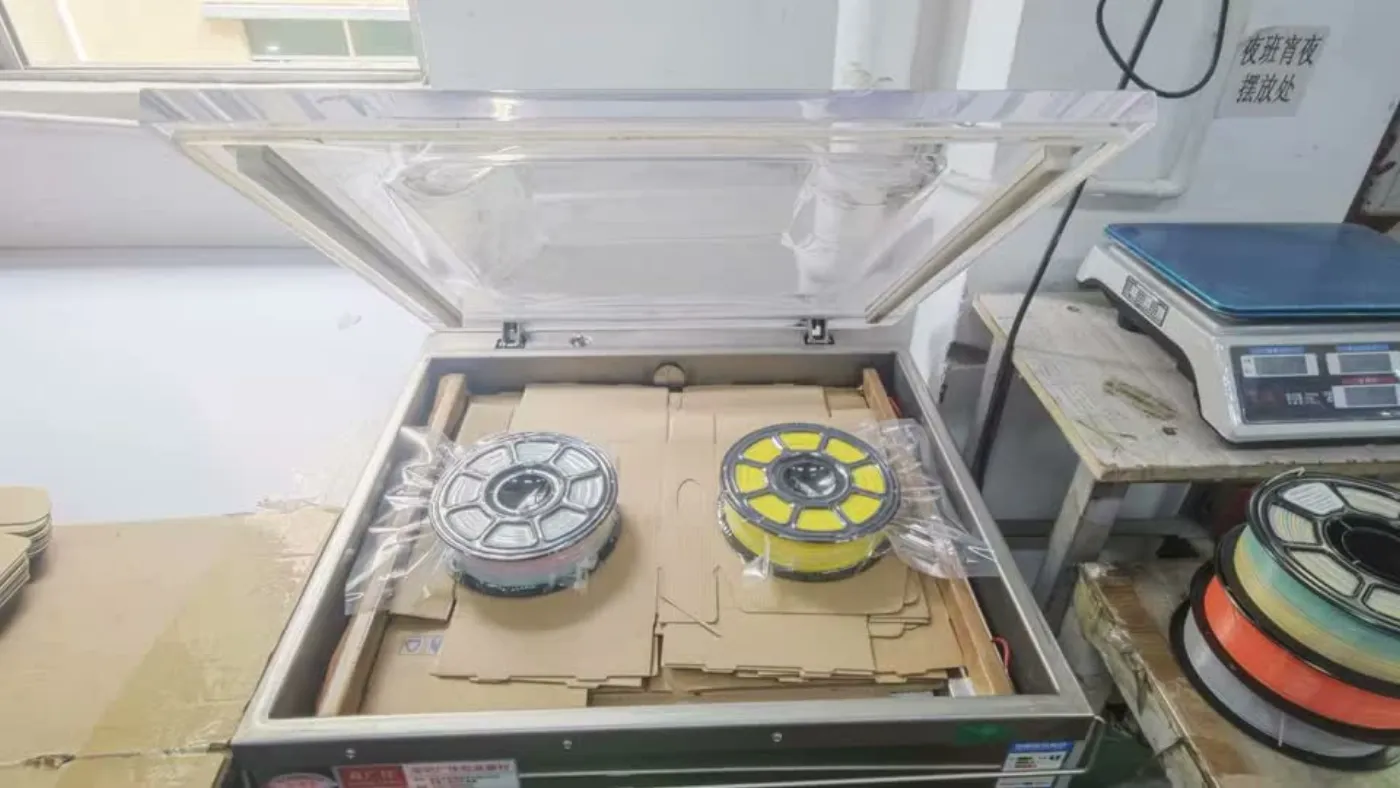
The carton arrives. Someone slices the tape, lifts out a box, and for two seconds holds a decision the whole supply chain has been working toward: is the vacuum film still tight against the spool, or did moisture get there first? Everything upstream only matters if the packaging holds.
Filament packaging gets treated as the boring end of a technical product, which is strange, because for a hygroscopic material it is the only quality control that travels with the goods. A spool that leaves the plant dry arrives dry only if the film, the desiccant, the box, and the label all held. The material science behind moisture itself sits in our PETG and PLA explainers.
What Moisture Does to a Spool
The short version, by material. Wet PLA turns brittle and prints with popping sounds, and brittleness shows up at the worst moment: in a customer’s hands, after a sale. Wet PETG strings, bubbles, and lays down weak layers, which surfaces as failed long prints and support-ticket photos. When it happens, the recovery protocol is in our guide to drying filament. The polymer doesn’t care whose logo is on the box; given air and time, it takes on water, and the printer reports the result.
What makes moisture expensive is the lag. The spool that arrives damp was usually sealed damp or breached in transit, weeks before anyone printed with it, and by the time the symptom appears the conversation has drifted to printer settings and return shipping. Good packaging shortens that conversation to a photograph of a seal, taken on arrival, before a single print muddies the evidence.
What the Seal Actually Does
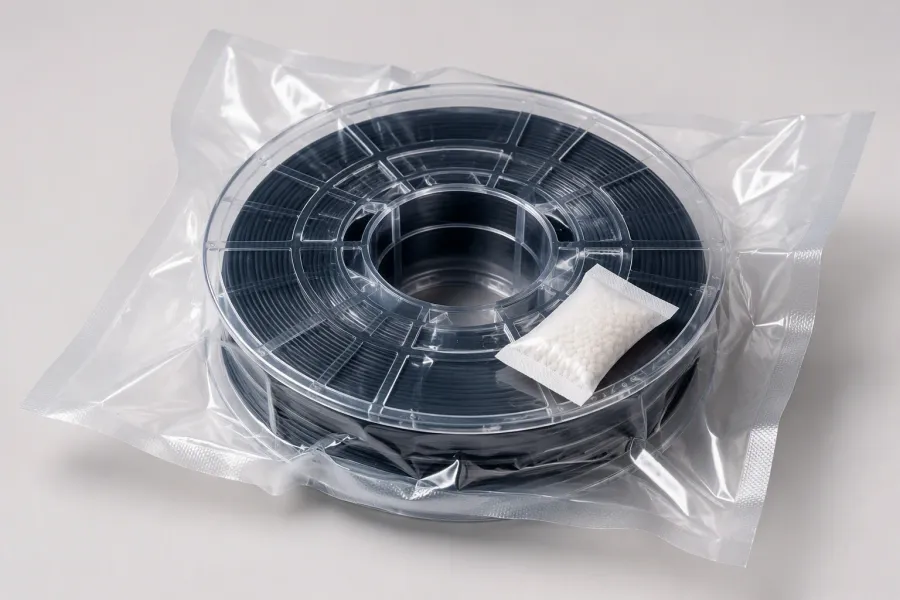
A vacuum bag and a desiccant sachet solve two different halves of the same problem. The vacuum pulls the air, and with it most of the water vapor, away from the filament surface, and collapses the film tight against the spool so the barrier is in contact with the product. The desiccant handles what the vacuum can’t: the residual moisture in the bag and whatever migrates through the film over time. Remove either half and the system degrades. A sealed bag with no desiccant slowly equalizes with its own trapped air. A desiccant in a loose bag fights the entire atmosphere of a shipping container, and loses.
Two myths to clear. Vacuum sealing doesn’t dry filament; it preserves whatever dryness the spool had at sealing, which is why drying happens upstream, in the plant, before the film goes on. And the sealed bag isn’t a lifetime guarantee. It’s a barrier with a condition, and the condition is checkable on your receiving dock. Storage plays its part on your side: a sealed box in a dry storeroom and the same box on a sunny dock are living different lives.
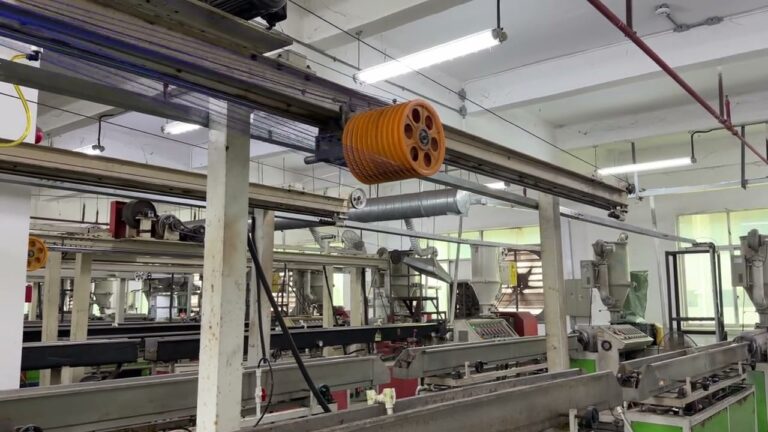
That’s also why our standard packaging is vacuum film plus desiccant for every spool, boxed individually, a step that sits inside the assessed production flow itself, right between extrusion and cartoning. It’s also why the seal matters more for filament bound for humid destinations: a spool crossing an ocean in summer isn’t in a gentle environment, and the film is the only thing between the resin and the weather.
The Journey and the Arrival Check
Between the plant and your dock, a carton experiences a logistics weather system: container humidity that cycles every day at sea, warehouse seasons, the climate of whatever port it sat in. Sealed boxes in storage want the obvious: dry, indoor, off the floor, away from the wall that catches afternoon sun. “Reasonable conditions” means a space you’d be comfortable storing cardboard in, because the box protects the bag and the space protects the box. Suppliers can’t control the weather between here and you. What they control is whether the spool enters that system sealed, with a desiccant standing guard, and whether their own warehouse stores finished goods sensibly in the meantime — a question worth asking directly, because plant storage sits upstream of everything the freight does. Seal integrity, not seal age, is the variable that matters, so the right question about any sealed spool is physical, and yours to answer in under a minute per box.
The arrival check, in the order that catches the most:
- Film tension, first. Vacuum should hug the spool; loose or ballooned film means the barrier broke somewhere en route.
- Desiccant present. Open one box from each lot and confirm the sachet is present and intact.
- Carton condition. Crushed corners and water staining tell you what the contents went through.
- Label match. Box, spool, and packing list should agree on SKU, batch, and net weight before anything reaches a customer.
- Spot weigh-in. One spool per lot on a scale, net against spec, closes the loop on the one number everyone feels.
Photograph what you find, especially the failures. A dated photo of a loose film next to the supplier’s spotless finished-goods record is the most persuasive document a quality conversation can contain. Build the photo protocol into receiving itself: carton exterior before opening, film condition per spool sampled from each lot, the desiccant in place, and the label close enough to read. Four frames a lot, taken with the phone already in someone’s pocket, and the evidence file builds itself on the days nothing is wrong as well as the days something is.
Box-Level Decisions
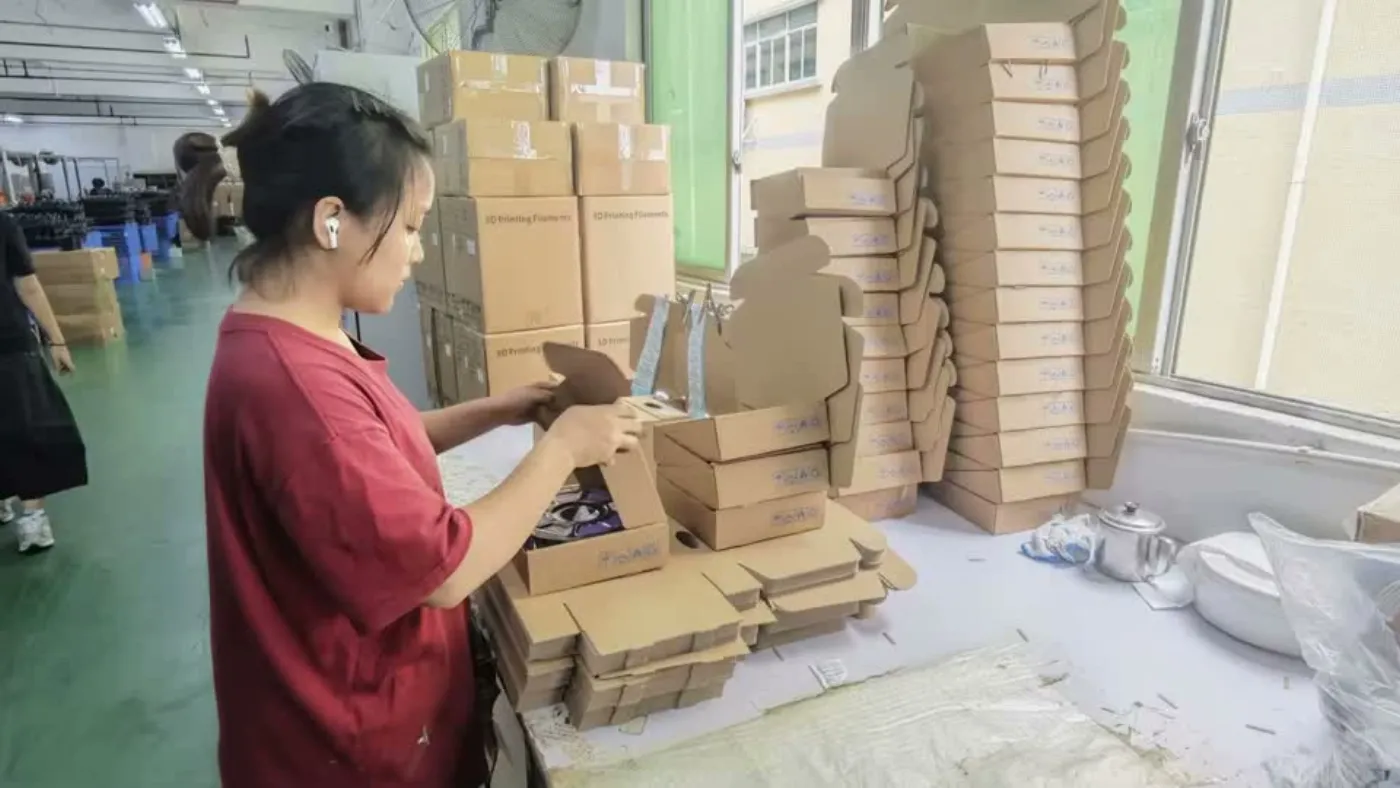
Under the film sits a box, and the box is a working decision with freight consequences. Our single-spool carton measures 21.1 by 19.8 by 6.3 centimeters, and those dimensions pack into shipping cartons at a density that keeps freight cost sane per kilogram of filament. Multiplying that across a pallet explains why box geometry is a money conversation: a centimeter of wasted box height, repeated across a pallet, is freight you paid for air. Buyers moving volume should run this math once with their own freight rates, because the answer tends to survive contact with any carrier’s quote. Carton strength belongs in the same conversation when pallets stack in a container, and window or die-cut options belong there when the shelf needs to show the spool. All of it is cardboard engineering with cost attached. Change the spool format and the math changes with it, so box geometry belongs in the conversation the moment you discuss anything beyond standard product.
Labels and barcodes are box-level too. Placement, language, compliance marks, and the barcode your warehouse actually scans all get specified up front, and errors here surface as channel problems: a mis-scanned SKU in a fulfillment center costs more labor than the box saved, and a label that peels in humidity turns retail shelves into your maintenance budget. Get the label proof approved in writing with everything else, and keep a signed copy in the order file — when a carton arrives with a wrong barcode six months later, the proof is what turns the correction from a negotiation into a reprint.
The box is also shelf presence, the part your customers actually see. Print quality on the carton, the photography on it, and how the spool presents through any window all price into perceived value, which is why packaging deserves the same approval discipline as color: physical proof, signed off, before volume runs.
Market-Specific Packaging
Packaging localizes, and pretending otherwise costs sales. The same spool ships with market-appropriate presentation for the US, Brazil, France, and Germany: language, layout, and retail conventions adjust, because a box designed for one shelf tradition can look wrong on another, and “looks wrong” quietly becomes “sells less.” In practice the localization conversation covers language and layout first, then the marks each market expects on the carton, then the visual conventions of the channel: big-box retail, hobby shop, and marketplace fulfillment each present a box differently. At review stage, compare the proofs on four axes across markets: language correctness, layout fit to the box face, the marks each channel expects, and whether the variant still reads as one brand. A variant that drifts on the fourth axis costs more than a translation ever will. Review the actual variant for each market you sell into, at proof stage, with the same eyes you’d use on a product photo. If your channel mix includes both retail shelves and marketplace fulfillment for the same market, say so early: the two reward different faces of the same box, and the packaging conversation is cheaper before artwork exists than after it ships. Buyers planning multi-market distribution should ask to see the market variants themselves instead of settling for a single hero photo, and should treat packaging localization as part of the product decision, equal in rank to color range.

Packaging in Qualification
Two structural facts make packaging easier to negotiate than most buyers expect. First, packaging minimums quote separately from filament minimums, so a trial can run in standard packaging while custom work is priced on its own ladder. Second, packaging upgrades follow a staged path: neutral packaging first, then labels, barcodes, and inserts, then full custom boxes and spools for private-label programs at higher volumes. Each step is a real decision with its own economics, and the trial stage in the supplier qualification process deliberately uses standard packaging so you see the supplier’s baseline, uncurated.
Specify packaging the way you specify diameter: film and desiccant as standard, box dimensions confirmed, label proof approved in writing, market variants reviewed for the shelves you actually sell on. A buyer running the qualification stages described elsewhere can fold packaging into the same flow: standard packaging at the trial stage to see the baseline, label and barcode proofs during the first commercial order, and the full custom program once volumes justify the design work. Each step has its own approval artifact, and the file you build is what makes reorder number ten as boring as reorder number one, and boring is the goal. The packaging step’s place in the production flow is in the manufacturing walkthrough, and the private-label packaging path itself sits on the OEM and private-label manufacturing page. More about FilaSource is on the homepage.
Frequently Asked Questions
How long does vacuum sealing protect filament?
There’s no calendar answer, because seal integrity is a physical condition you can check; a date on the bag tells you nothing. An intact film with desiccant keeps a spool dry for its shelf life; a film nicked in transit starts losing the argument immediately. Check the seal on arrival and store sealed boxes in reasonable conditions.
Should I reseal opened spools?
Yes, with desiccant, and label the bag with the date. Resealing slows further uptake while the spool waits; moisture already absorbed takes drying. First-in-first-out rotation keeps the inventory honest.
What is the desiccant in the bag for?
It absorbs the residual moisture vacuum can’t remove and what slowly migrates through the film over time. Film and desiccant work as a pair; either one alone gives partial protection at best.
Can I dry filament without opening the packaging?
No. Drying needs airflow around the filament at temperature, which the sealed film prevents by design. Open, dry per the material’s spec, then reseal with desiccant. Request the per-material drying guidance from your supplier before the first order.
Can packaging be customized for my brand?
Along a defined path: standard or neutral packaging, then labels, barcodes, and inserts, then full custom boxes and spools. Packaging minimums are quoted separately from filament minimums, and label proofs are approved in writing before anything prints.