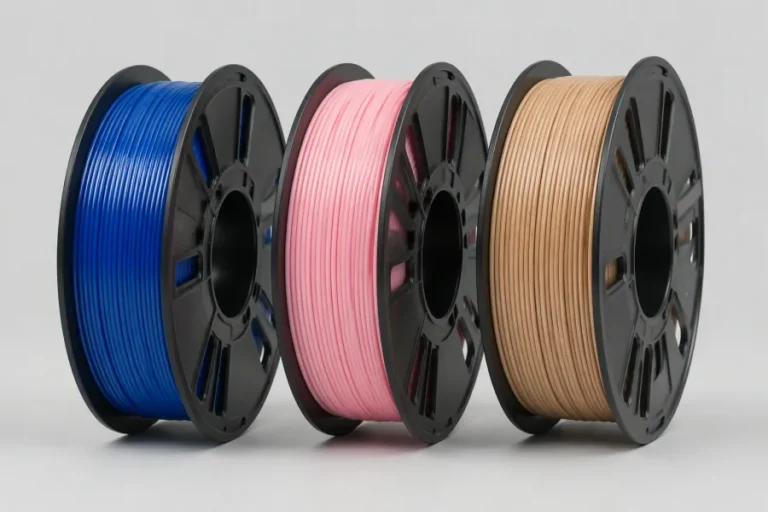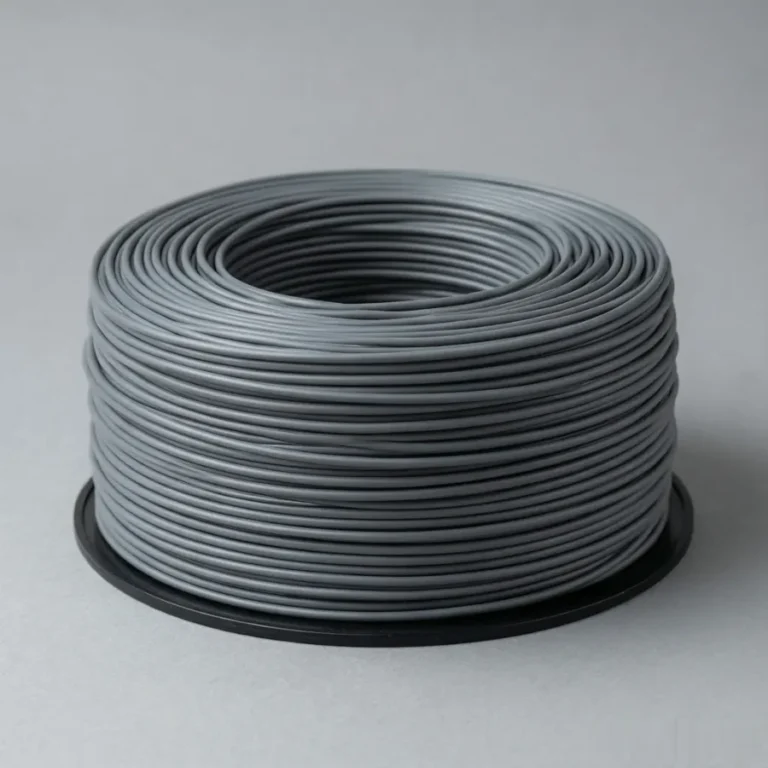
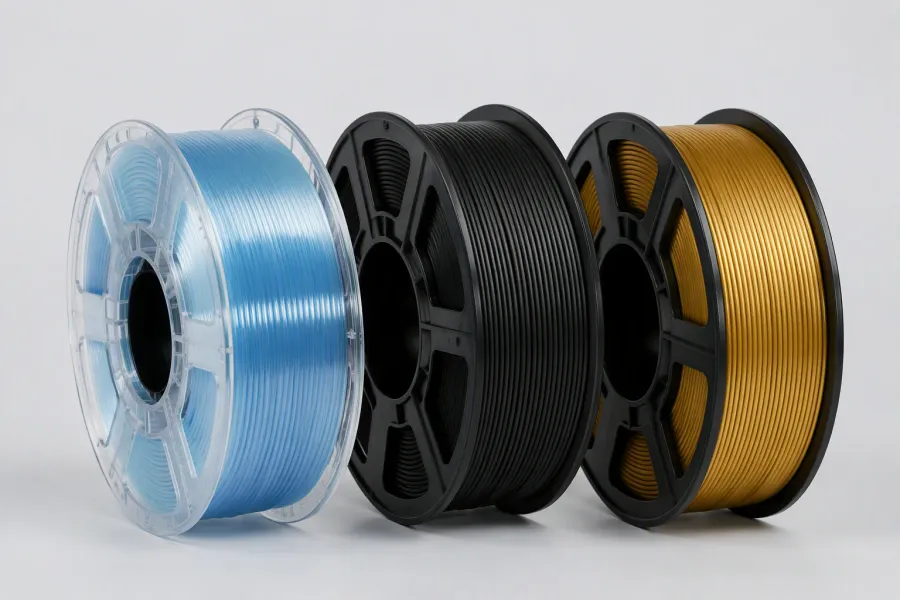
Add carbon fiber or glass fiber to PETG and you get a stiffer, steadier material, but not the same one. Carbon produces the stiffest, lightest parts, with a matte, technical look. Glass delivers much of that reinforcement with a different finish and a different weight. Underneath, the PETG keeps supplying toughness and chemical resistance, so choosing between PETG-CF and PETG-GF comes down to the job the part does, the look it needs, and what your machines can run.
Search PETG CF vs PETG GF and you’ll mostly land on forum fragments and product listings. That’s thin ground for a purchasing decision.
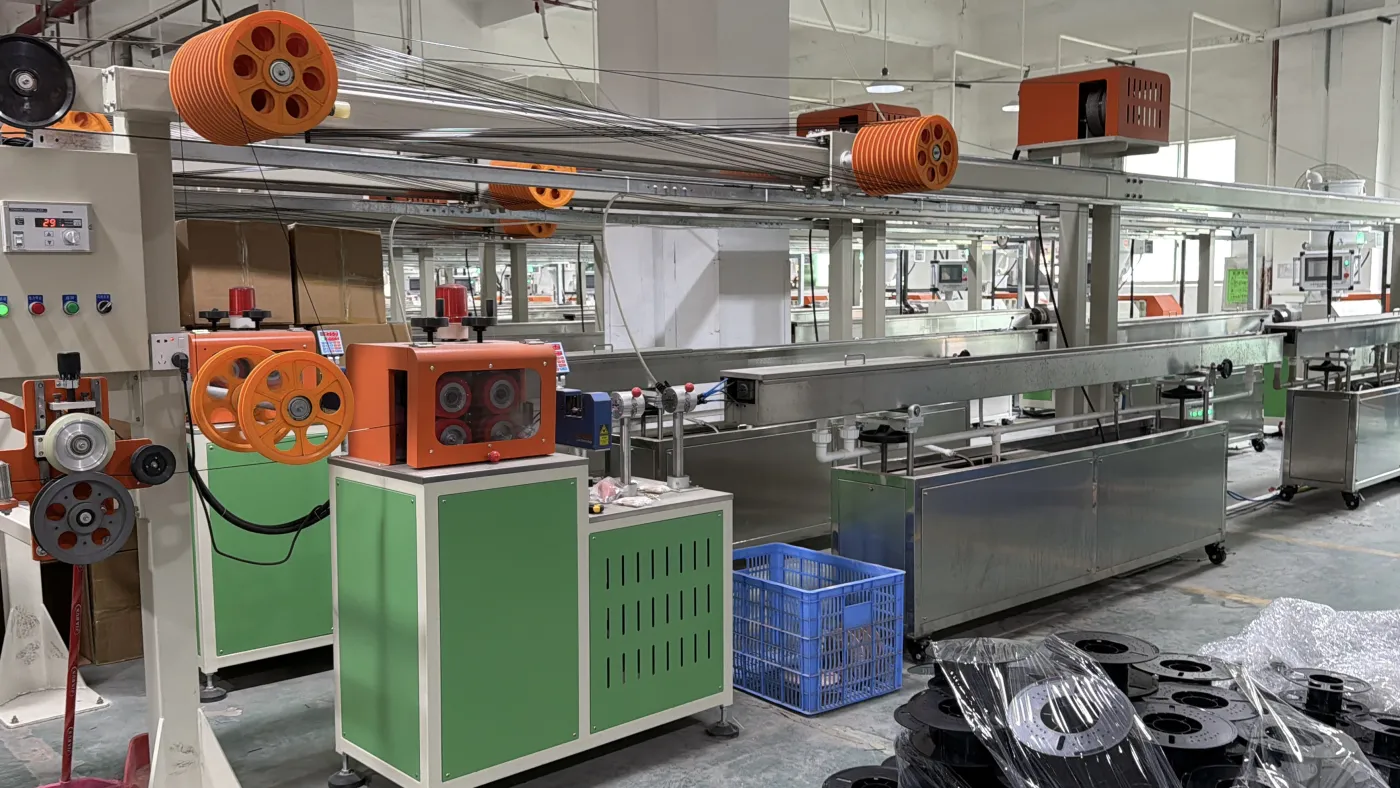
What the Fibers Change
Carbon fiber segments make PETG noticeably stiffer, take weight out of the part, and give it a matte, technical surface that hides layer lines. Glass fiber stiffens PETG too, though it reads differently: the surface is less matte than carbon’s, and the two fibers don’t weigh the same. Both cut the warping that unfilled PETG shows, which is a big reason reinforced grades turn up in functional work.
Neither fiber makes PETG tougher. A stiffer part forgives less before it breaks, so if yours has to take bending, impacts or clamp loads, plain PETG or a different family might do better. Test the real application instead of trusting a reinforcement label.
What Both Grades Share
Whichever fiber you pick, three requirements come along with it.
Hardened nozzles. Both fibers are abrasive. Brass nozzles wear faster on filled material, the aperture opens up, and print quality slips well before the nozzle actually fails. Hardened steel is the standard recommendation for PETG-CF and PETG-GF alike, and it belongs in the budget for either grade.
The same PETG processing window. Both are PETG underneath, so plan on a nozzle range around 220–255 °C and a heated bed at 50–80 °C, with the supplier’s settings sheet for the exact grade as the starting point. A matte CF surface shows defects more readily than glossy plain PETG, which helps when you’re validating and punishes sloppy profiles.
The same consistency risk. In reinforced grades the variable to watch from batch to batch is fiber dispersion, meaning how evenly the fiber is spread through the melt. Poor dispersion shows up as patchy stiffness or visible streaks. The safeguard is the usual one: validation across two independent production batches, with the diameter logs from each. Our specification is 1.75 mm held to ±0.02 mm with in-line monitoring during production.
Choosing Between Them
If the decision really is between the two, four questions settle most of it:
- What should the surface look like? CF’s matte, technical finish suits enclosures, jigs and anything that gets handled. GF’s finish reads differently and can suit functional internals where looks matter less.
- How much does the part weigh? When weight counts, as with drone parts or brackets on moving assemblies, carbon’s stiffness for the weight is usually why it wins.
- What can your machines run? Both want hardened nozzles, and neither should be the first filled material your fleet has met. The changeover routine is the same either way.
- What does the application actually need? Plenty of parts get specified in CF because it sounds stronger, when the real requirement is dimensional stability, and both grades deliver that.
Supplier checks don’t differ between the two either. The PETG-CF supplier qualification guide walks through the audit, from dispersion checks and nozzle economics to drying discipline and the manufacturer-versus-reseller question, and every item carries over to GF grades.
Drying and Packaging, Unchanged
PETG is the more moisture-sensitive of the common workhorse materials, and reinforcement doesn’t alter that. Spools should arrive vacuum-sealed with desiccant, and the drying spec for the material should be available on request. The routine for storage (dated bags, first-in-first-out, a drying station between storage and machines) is laid out in our storage guide and the wet filament guide, and filled grades follow it exactly as plain ones do. One difference is worth knowing. Matte CF surfaces show moisture symptoms sooner than glossy ones, so the material can tip you off to a storage problem before it ruins a long print.
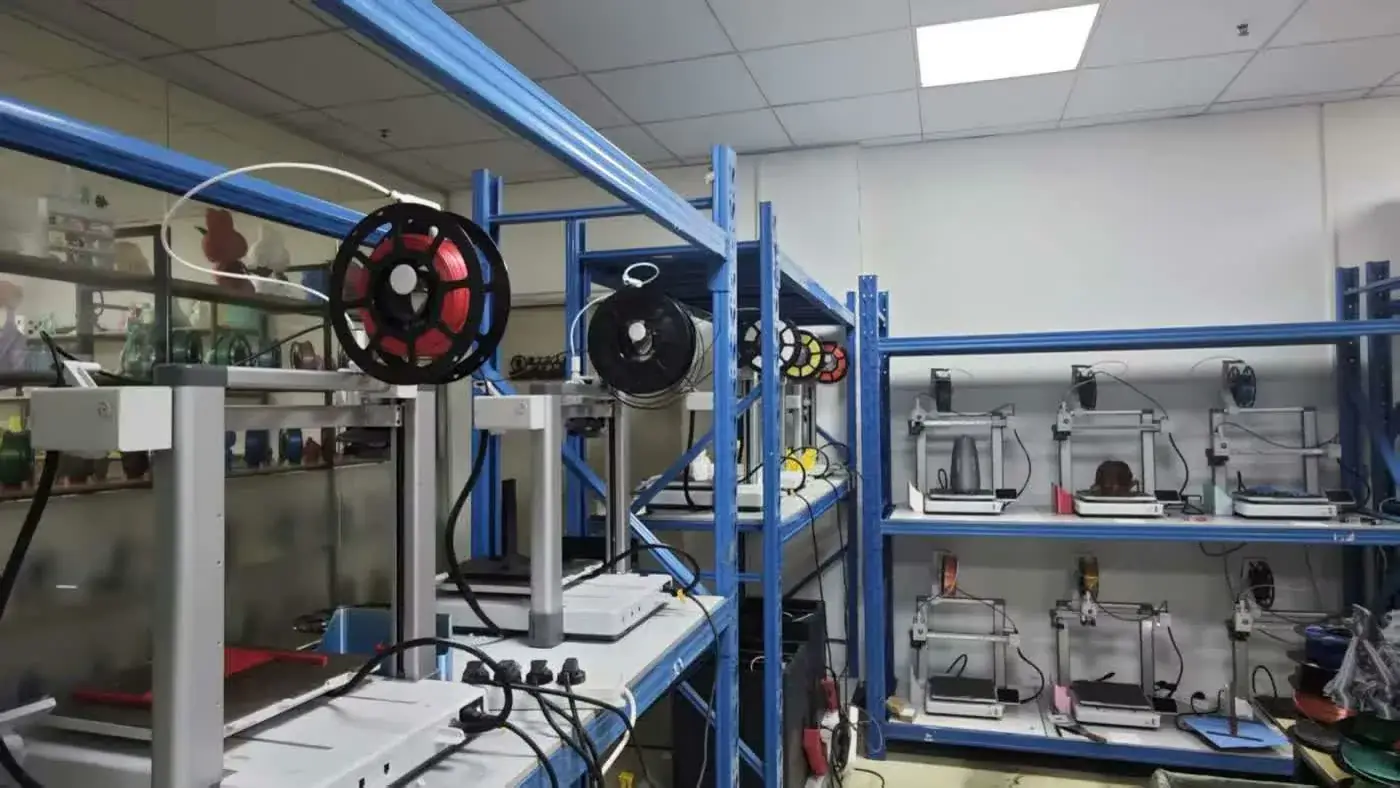
Verifying Either Grade Before Volume
Whichever fiber you choose, the qualification steps are the same. Print one test geometry from two independent batches and compare stiffness, surface texture and dimensional behavior, using the supplier’s settings sheet as your baseline. Check each batch’s diameter log against the ±0.02 mm specification on both axes, because ovality can hide from a single-axis reading. Confirm that packaging arrived intact and photograph anything doubtful. The base polymer is covered in our PETG explainer, and the logic of tolerance checks is in the diameter tolerance guide.
Both grades sit in our PETG range, and the route from samples to volume starts on the PETG filament manufacturer page. More about FilaSource is on the homepage.
Frequently Asked Questions
Is PETG-CF stronger than PETG-GF?
In most formulations it’s stiffer: carbon fiber generally gives more stiffness for its weight than glass. Whether it’s stronger depends on what you’re measuring. Impact behavior and layer adhesion follow their own rules, and reinforced grades trade flexibility for rigidity, so test the real application rather than ranking labels.
Do both grades need hardened nozzles?
Yes. Carbon and glass fibers are both abrasive, and brass nozzles wear faster against either. Hardened steel is the standard recommendation, and the swap belongs in the budget for running filled materials.
Which one has a matte surface?
Carbon fiber grades print with a matte, technical surface that hides layer lines. Glass fiber grades finish differently and look less matte. If appearance drives your choice, print a sample of each on your own machine.
Do they print at the same temperature?
Close to it. Both are PETG-based, so expect roughly 220–255 °C at the nozzle with a 50–80 °C bed, but the settings sheet for the specific grade is the reference. Filled materials can behave differently on the first layer, so validate on one machine before rolling out to a fleet.
How do I verify fiber consistency between batches?
Print the same test part from two independent production batches and compare stiffness and surface texture, with each batch’s diameter log beside you. Consistent dispersion shows as uniform finish and predictable rigidity across both batches.