Storage is the least glamorous chapter in filament, and the most expensive to get wrong. A shelf of spools is inventory, inventory is cash, and hygroscopic inventory is cash slowly arranging its own destruction. The hobbyist forum answer — “get a box” — isn’t wrong, exactly. It’s just written for three spools on a desk, and it says nothing about the point where storage becomes a system: dated bags, rotation discipline, warehouse zones, and the supply-chain fact that determines how much work your storage actually has to do.
How to store 3D printer filament is the same physics at the bench, the stockroom, and the farm shelf. The consequences differ.
One distinction worth fixing early, because it saves money: dry storage and drying are different jobs. Storage holds a spool at the dryness it already has; drying removes water a spool has already taken on. Buying a dryer to solve a storage problem means running rescue cycles forever; buying storage to solve a drying problem means never fixing the batch that arrived damp. Diagnose which problem you have, using the bend test and the arrival check, and spend on the matching half.
Three Questions Before Any Storage Purchase
Before buying boxes, dehumidifiers, or anything with a marketing budget, answer three questions about your own operation. How deep is your inventory, weeks or months of stock? Deeper inventory makes environment matter more than containers. What’s your ambient humidity, honestly, across seasons? A dry climate forgives a lot; a coastal warehouse forgives nothing. And how fast do spools actually move, first-in-first-out within weeks, or shelf-queens for quarters? The answers determine whether you need a better room, better bags, or just better discipline, and the cheapest answer is usually the discipline.
What You’re Actually Storing Against
Water, mostly. Filament absorbs moisture from ambient air, and damp filament fails in print: PLA turns brittle and pops, PETG strings and lays weak layers. The drying guide covers the rescue; storage is everything before the rescue becomes necessary.
The enemy is time-in-contact-with-air. A spool opened yesterday on a dry bench is a non-issue. The same spool, loosely bagged through a humid season, is a support ticket waiting to be written. Each practice in this protocol cuts that contact time.
The Bench Scale of Storage
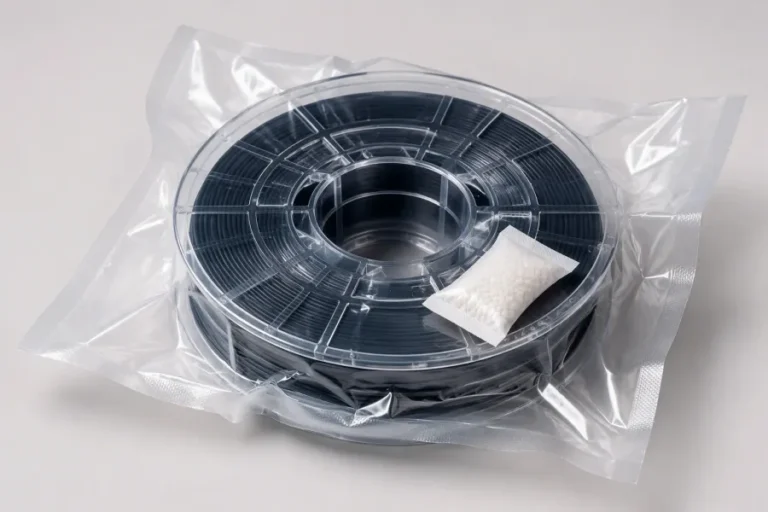
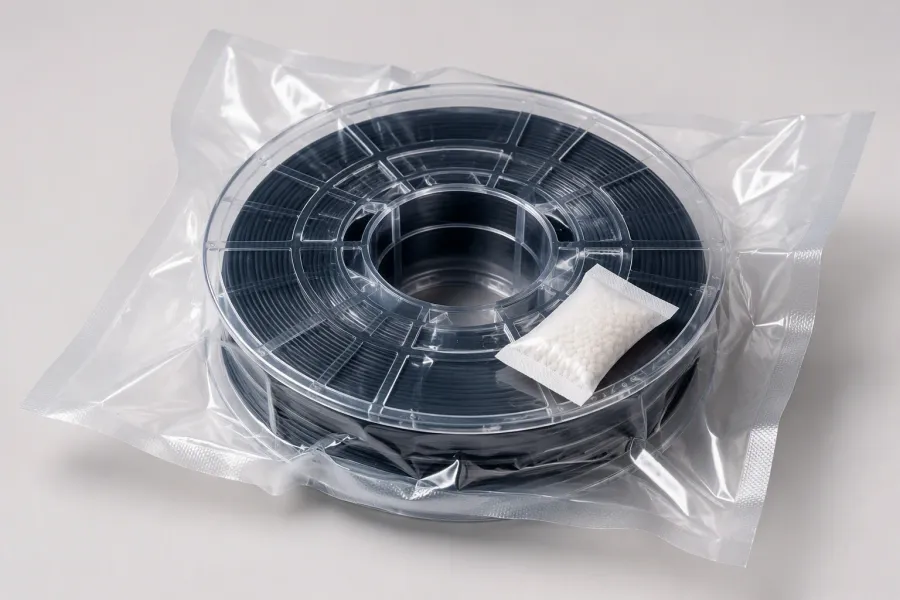
For a handful of spools in active rotation, the protocol fits in one line: sealed bag, desiccant sachet, air pressed out, end fixed, date on the bag with a marker. The bag can be the one the spool shipped in if the ziplock still closes; the desiccant can be the sachet that shipped with it, refreshed or replaced when the crystals indicate. The date matters more than people expect — a dwell limit you can’t see is a dwell limit you don’t have, and “when did I open this” is the question the marker answers for free.
The shelf itself wants the boring virtues: out of direct sun, away from the window wall, and clear of the printer’s heat zone. Spools standing on edge in individual bags beat spools stacked flat and touching, both for moisture and for the winding-order reasons covered in our tangle guide.
The Stockroom Scale of Storage
At inventory scale, storage becomes logistics. The practices that hold:
- First-in, first-out, religiously. Sealed spools age slower than opened ones, but nothing ages slower than the spool you sell before it can age at all. FIFO keeps the oldest stock moving out the door rather than into a forgotten corner.
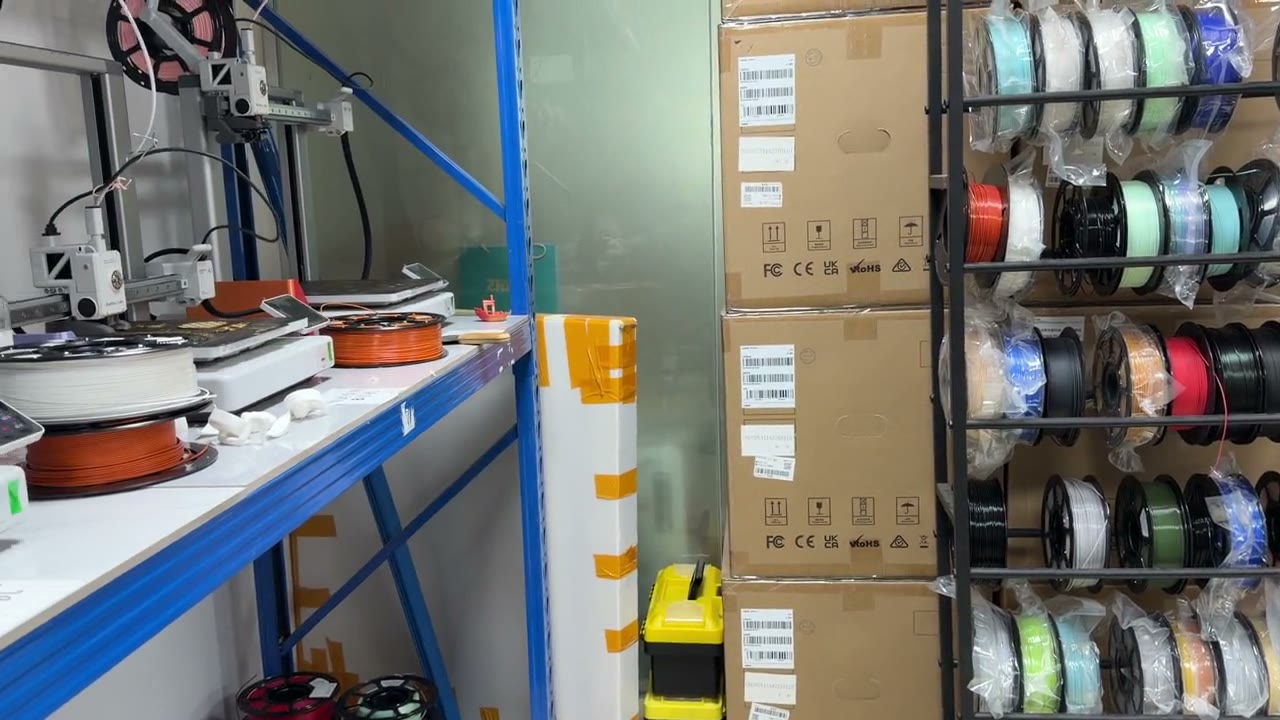
- Two zones: sealed and opened. Sealed cases store by the pallet; opened spools live in the active zone with their dated bags. The zones never mix, because mixing them kills FIFO.
- Environment over gadgets. A dry, temperature-stable room outperances any box in a damp room. Address the room first; the containers second.
- A monthly walk. Someone opens the storage area, checks seals on a sample, looks for damaged cartons and bag failures, and writes a line in a log. A ten-minute monthly walk makes the stock’s condition known instead of assumed.
Resellers and brand owners should add one more habit: photograph the storage area’s state when a delivery lands. If a customer dispute about moisture ever surfaces, a dated photo of intact sealed cartons is the quietest way to end it.
The Farm Shelf Scale of Storage
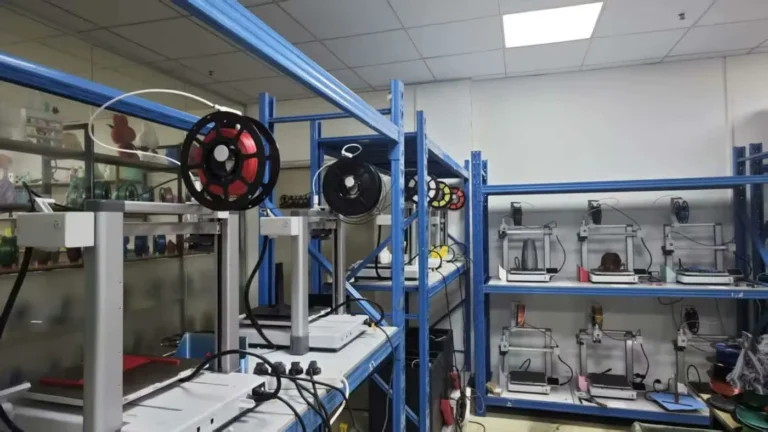
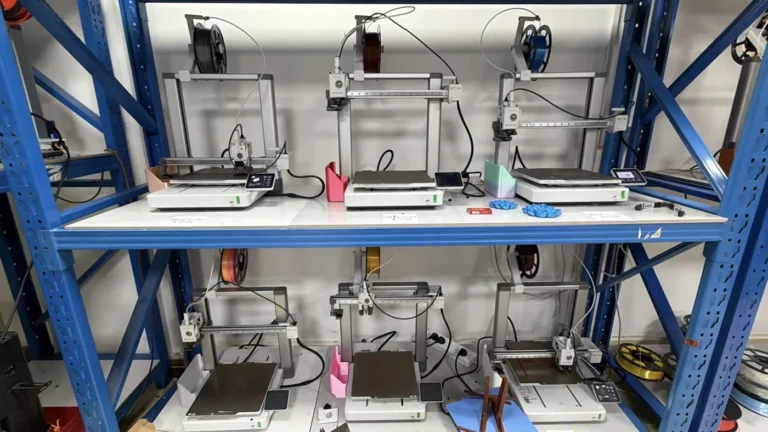
A farm’s shelf is a production system, and it earns engineering. The layout that works: active spools at the machines in sealed bags with desiccant, a drying station as the gateway between storage and printer, and a spool log that records what went onto which machine and when. Rotation is FIFO with a twist — partially used spools return to the front of the queue so dwell time stays visible and short.
The farm-specific failure mode is optimism: “we’ll bag it after this batch.” After this batch is when the humid week arrives. The dry-and-return discipline — spool back in its bag the same minute the print ends — is the entire difference between a farm that thinks about moisture once a quarter and a farm that thinks about it every failed run.
Four Topics the Forum Skips
Desiccant is regenerable. Most silica sachets can be refreshed in a warm oven or a dedicated recharger until the indicator crystals return to their active color. Regeneration on a schedule keeps sealed bags working for months and costs almost nothing.
Per-material sensitivity varies. PLA and PETG both absorb moisture, but their failure symptoms differ — PLA leans brittle, PETG leans stringy — and their tolerance for shelf time differs with it. Segregating stock by material sensitivity, and drying the most vulnerable family first, is a stockroom habit worth adopting.
Skip the freezer. Cold storage invites condensation on the spool the moment it meets warm air, which is the opposite of the goal. Dry, sealed, ambient storage answers the question.
Vacuum bags work at bench scale. A hand-pump vacuum bag is not necessary for every spool, but for a prized partial spool heading into long storage, pulling the air out manually is a reasonable extra step.
Common Storage Mistakes, Ranked by Cost
The mistakes that do the most damage, in rough order of what they cost:
- The unlabeled open spool. Unknown dwell time is unbounded dwell time, and this one failure quietly defeats all the other practices combined.
- Storage against an exterior wall. Temperature cycling moves moisture through walls and through packaging; the corner that looks tidy is often the damp one.
- Sealed and opened stock mixed. FIFO collapses the first time a fresh case is opened ahead of a half-used spool, and it collapses silently.
- Desiccant assumed eternal. Sachets saturate. Refreshed on a schedule they are cheap insurance; forgotten, they are false security sealed inside a bag.
- Trusting the shipping bag forever. A ziplock that has been opened and closed twenty times is no longer the seal it was on day one, and a fresh bag costs a rounding error.
None of these is a knowledge problem. All of them are drift problems, habits that were perfect in month one and quietly evaporated by month six. The monthly walk catches drift before it becomes loss.
The Supply-Chain Half of the Problem
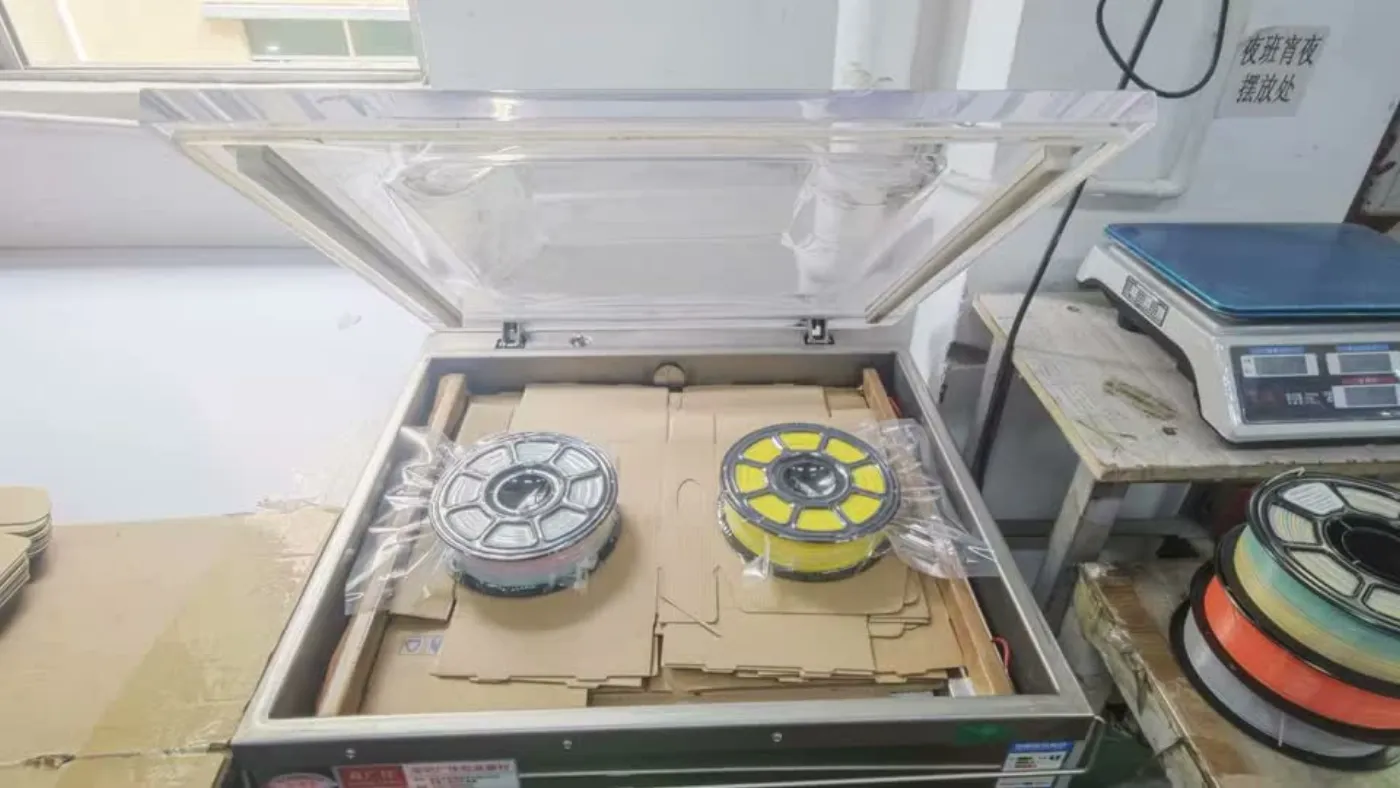
Here is the fact that shrinks every storage system’s workload: filament that arrives dry, in intact vacuum packaging with desiccant, starts its storage life from zero. Filament that arrives damp or in compromised packaging starts behind, and no shelf protocol catches up gracefully. The arrival check — film taut, sachet present, carton sound — is therefore a storage practice, arguably the first one. The full receiving protocol lives in our packaging guide.
On the supplier side, that’s the whole logic of shipping every spool vacuum-sealed with desiccant in an individual carton: the storage problem is solved best before it exists. When you’re qualifying a filament manufacturer, the packaging standard and the per-material drying spec tell you how much of your storage workload they’ve already absorbed. More about FilaSource is on the homepage.
Frequently Asked Questions
How should I store opened filament?
In a sealed bag with desiccant, air pressed out, end fixed, and the open date written on the bag. Store it standing on edge in a dry spot, and rotate stock first-opened-first-used. If a spool has been open in humid air for weeks, dry it before the next critical print.
Do I need a dry box for every spool?
For a bench, sealed bags with desiccant do the same job for less. Dry boxes earn their cost when spools sit idle for months, in consistently humid climates, or on a farm where inventory depth makes bag-handling labor impractical at the machine.
How long can sealed spools sit in storage?
Sealed, in a dry and stable room, spools hold for their shelf life; the seal and sachet are doing the work. Check seals on arrival and during the monthly walk, and rotate the oldest stock out first regardless of seal state.
Is a damp storage room salvageable?
Usually, by treating the room before the containers: a dehumidifier with a drain, sealed wall and floor penetrations, and no storage against exterior walls that sweat. Fix the room first, then judge the boxes.
Does storage matter if I dry before every print?
It matters more. Drying is a cycle of heat and time that costs energy and labor, and each cycle adds handling. Storage that keeps spools dry between runs means drying on schedule instead of by necessity, and the difference compounds at any scale beyond a single printer.